What a Music Video Storyboard Actually Does on a Shoot
A music video storyboard is not a piece of concept art. It is a working document that tells a crew what to point the camera at, in what order, and roughly how long each thing needs to last. It exists because a music video is the only format where the edit length is fixed before a single frame is shot. The track is three minutes and twelve seconds. It will still be three minutes and twelve seconds after the shoot. Everything you film has to fit inside that, in a specific sequence, against beats that are already written.
That constraint is what makes storyboarding useful rather than decorative. Most other filming work has flexibility in the edit. A music video does not. If you turn up with eleven brilliant shots and no coverage for the second chorus, you have a problem no amount of grading will solve.
What a storyboard is and why it comes before filming
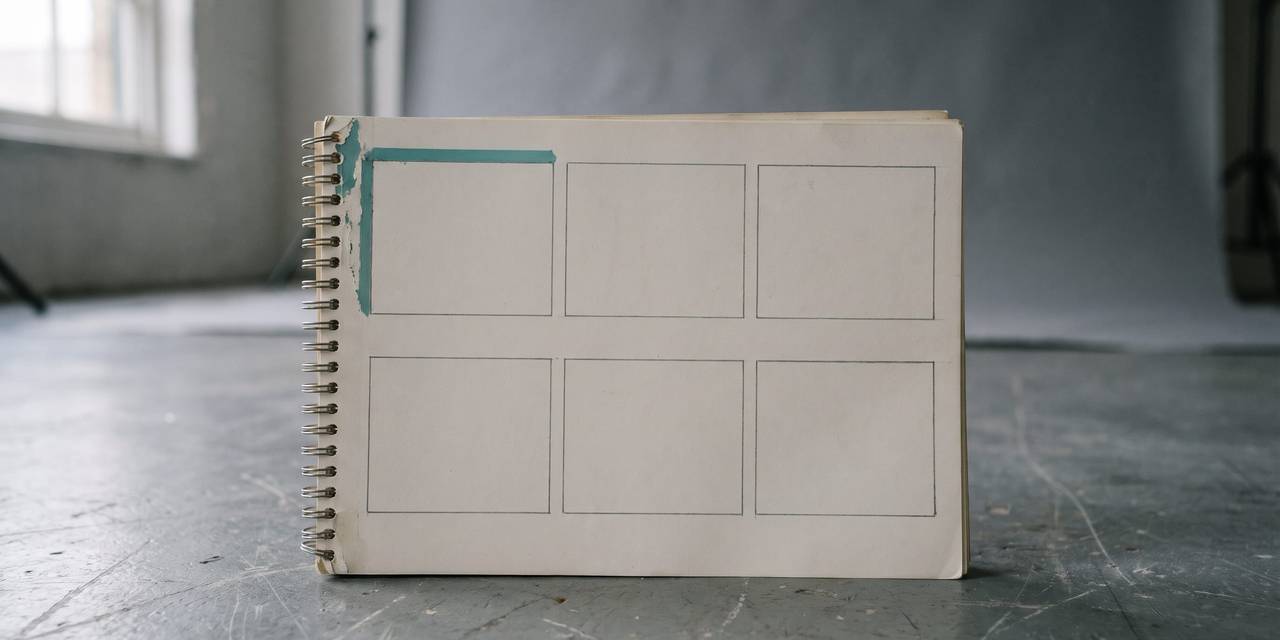
At its most basic, a music video storyboard is a sequence of frames showing what each shot looks like, annotated with camera movement, location, wardrobe, and where in the song it sits. Some are drawn by hand in a notebook. Some are assembled from reference photographs. Some are boxes on a page with written descriptions underneath. The format matters far less than whether a stranger could pick it up and understand the plan.
It exists before filming for three reasons.
The first is agreement. Everyone involved thinks they share the same idea until someone draws it. The moment a concept becomes a specific frame, with a specific location and a specific look, disagreements surface. Far better that happens a fortnight out than at nine in the morning on shoot day with a crew standing around.
The second is budgeting. You cannot cost a shoot accurately from a mood board. You can cost one from a storyboard, because a storyboard tells you how many locations, how many setups, how many crew, whether you need a drone, whether you need a second camera, and how many hours the whole thing realistically takes. Storyboarding is where ambitious ideas meet the available budget, and it is much cheaper to lose a shot on paper than to lose a day on location.
The third is coverage. This is the one artists underestimate. An editor cutting to music needs options at every transition point. The storyboard is where you check that you have them, before the opportunity to film them has gone.
The briefing conversation is where the storyboard actually starts
No useful storyboard begins with drawing. It begins with a conversation with the artist, the manager, or the label, and that conversation needs to cover more than the visual idea.
What is the song about, and does the video need to be about that? Plenty of videos deliberately run against the lyrics. That is a decision, and it should be a conscious one.
Where is this going? A video cut for a YouTube premiere is a different object from one being chopped into vertical clips for social. If vertical crops are part of the plan, that has to be designed in at the storyboard stage, because centring your subject for a 16:9 frame and then cropping to 9:16 throws away half the composition. Boarding for both means deciding which shots are the vertical ones.
Who is in it, and what can they do? If the artist is not comfortable acting, the storyboard should not depend on acting. If there is a dance crew, the choreography drives the shot structure rather than the other way round. If there are features on the track, their availability may be a single hour, and that shapes everything.
What exists already? Previous videos, the artwork, the EP cycle, the way the artist presents on stage. A video that looks nothing like the rest of the campaign is a missed opportunity even if it is a good video on its own.
And the unglamorous constraints: budget, shoot days, release date, locations already secured or already refused. These are not limitations on creativity. They are the shape of the problem, and the storyboard is the answer to that specific problem rather than a general one.
Mapping shots against song structure
This is the part that makes a music video storyboard different from any other kind. You board against the track, not against a page count.
Open the song in whatever editing software you have and mark the structure. Intro, verse one, pre-chorus, chorus, verse two, bridge, drop, final chorus, outro. Note the timecodes. Now the storyboard has a spine, and every frame you draw sits at a known point in the song.
Patterns emerge quickly once you work this way. Verses usually want more shot variety and more narrative movement, because they carry the lyrical information and the listener is paying attention to words. Choruses usually want fewer, stronger, more repeatable images, because the chorus repeats and the audience should recognise it when it comes back. If your first chorus and your final chorus look completely unrelated, the video will feel like it has lost its thread even if nobody can say why.
Bridges and breakdowns are where you can change register. Different location, different lighting, slow motion, a shift to black and white. The track has already told the audience something is changing, so a visual change there feels earned rather than random.
Drops want something to land on. A single held frame, a sudden wide shot, a cut to a completely new setup. Whatever it is, it needs to be filmed with the intention of landing on that beat, which usually means a cleaner, more deliberate shot than the ones around it.
Boarding against structure also exposes coverage holes. Count how many distinct shots you have for each section. If the second verse has two and the first has nine, you will feel that gap in the edit, and the fix is to board more now rather than invent something on the day.
Turning the storyboard into a shot list
The storyboard says what the video looks like. The shot list says how the day runs, and they are not organised the same way at all.
A storyboard runs in song order. A shot list runs in shooting order, which means grouping by location, by lighting setup, by wardrobe, and by who is needed on camera. You might shoot the final chorus first because the light is right, then the opening shot last. That is completely normal, and it is why you need both documents rather than just the pretty one.
Each line on the shot list should name the setup, the lens or framing, the camera movement, the location, the wardrobe, and the storyboard frame it corresponds to. Keeping that reference link matters, because on a fast-moving day it is the only way to tick off coverage with confidence.
Then add time. Honest time, including the setup, the resets, the wardrobe changes and the travel between locations. This is where overambitious plans get caught. If the list adds up to fourteen hours and you have booked nine, you cut shots now on paper, in a calm room, rather than losing them later in a panic.
Mark the non-negotiables. Every video has a handful of shots the whole thing depends on. Those get flagged, and they get shot early. If you lose the light or the venue or the energy, you want to lose the nice-to-haves, not the spine.
How it changes on the day
Storyboards change. Any crew that tells you otherwise is describing a shoot that has not happened yet.
Weather turns. A location falls through or looks different from the recce. A multicam performance setup means one angle is covering what you boarded as three separate shots, and suddenly you have time back. An artist finds a movement or an expression in take four that is better than anything planned, and the right call is to build round it.
The storyboard is what lets you make those calls intelligently. When you deviate, you can look at the board and see exactly what you are giving up, whether that section still has coverage, and what you need to pick up before you wrap to keep the edit intact. Without it, improvisation is just hoping.
Practically, that means one person holds the board and the shot list and tracks what has actually been captured. At every location change, check the remaining list against the remaining time. Keep ten or fifteen minutes spare at each setup for something unplanned, because the unplanned shot is frequently the one that ends up in the trailer.
Starting the process
If you are planning a video, bring the track, any reference you like, the release date and the honest budget. The storyboard then gets built around those things rather than around a template. You can see how this fits into the wider process on our music video production page, which covers how a shoot is crewed and delivered once the plan is agreed.
If you already know roughly what you want and need to know what it costs, get a fast quote from Flexxed and we can talk through the concept and what it will take to shoot it properly.
Questions
Frequently Asked Questions
Do I need a storyboard for every music video?
Not always. A single-location performance video with one camera setup can often be planned with a shot list alone. Storyboards earn their keep when there is narrative, multiple locations, choreography, or anything that has to be cut precisely to the track.
Does a storyboard have to be drawn well?
No. Stick figures, boxes and arrows are fine. The purpose is to communicate framing, movement and order clearly enough that a crew can act on it. Nobody on set is judging the artwork.
Who makes the storyboard, the artist or the production company?
Usually the production side draws it, but the content comes from the artist or label. The briefing conversation decides what goes in it, and the artist signs it off before anything gets booked.
How long does storyboarding take?
It depends on how settled the concept is. A clear brief with a decided treatment can be boarded quickly. If the concept is still being argued over, the storyboard stage is where that argument happens, and that is time well spent.
What happens if we go off the storyboard on the day?
That is normal and often a good sign. The storyboard exists so that when you deviate, you know exactly what you are trading away and whether the edit will still work.